In-Hand Salary Calculator : How to Calculate Take-Home Salary from CTC
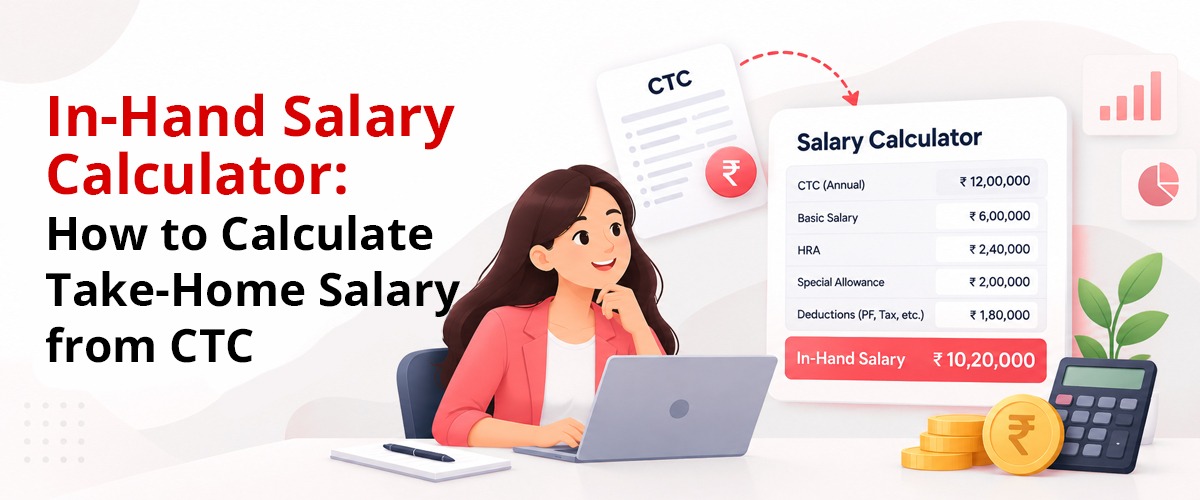
An in-hand salary calculator shows how much money you actually receive in your bank account each month. It starts with your CTC, removes employer-side costs to get gross salary, then subtracts PF, ESI (if applicable), professional tax and income tax (TDS). The result is your take-home salary.
Your offer letter may say ₹12 lakh per year, but your bank credit will never be ₹1 lakh a month. That gap confuses employees and creates questions for HR every payroll cycle. This guide explains the salary calculation formula in simple steps, with worked examples based on FY 2026-27 rules.
You will also learn how to read a payslip, why a basic payroll calculator is not enough for growing businesses, and how HRMS4U automates payslip generation for your whole team.
What Is Take-Home Salary? CTC vs Gross vs In-Hand
Take-home salary, also called in-hand or net salary, is the amount credited to your bank account after all deductions. It is always lower than your CTC and your gross salary.
| Term | What it means | Example (₹12 LPA) |
|---|---|---|
| CTC (Cost to Company) | Total yearly amount the employer spends on you, including employer PF and other benefits | ₹12,00,000 a year |
| Gross salary | CTC minus employer-side contributions such as employer PF and gratuity | ₹97,000 a month |
| In-hand (take-home) salary | Gross salary minus employee PF, ESI, professional tax and TDS | ₹93,800 a month |
In short: CTC is what the company pays, gross is what you earn, and in-hand is what you receive.

Salary Calculation Formula Explained
Every in-hand salary calculator uses two simple formulas:
Gross Salary = CTC − (Employer PF + Employer ESI + Gratuity + other employer benefits)
In-Hand Salary = Gross Salary − (Employee PF + Employee ESI + Professional Tax + TDS + other deductions)
Salary components (what you earn)
- Basic salary: the fixed core of your pay. Under the new wage codes, basic plus DA should be at least 50% of total remuneration.
- HRA (House Rent Allowance): helps with rent. It is tax-exempt only under the old tax regime.
- Special allowance: the flexible balance of your salary. It is fully taxable
- Bonus or incentives: performance or festival pay, taxed in the month it is paid.
Deductions (what reduces your take-home salary)
| Deduction | Rule for FY 2026-27 |
|---|---|
| Employee PF | 12% of PF wages. The statutory wage ceiling rose from ₹15,000 to ₹25,000 a month from 17 September 2026, so the capped employee share is now up to ₹3,000 a month. |
| Employee ESI | 0.75% of gross wages, only if monthly gross is ₹21,000 or less. The employer adds 3.25%. |
| Professional tax | Set by each state, up to ₹2,500 a year. Some states do not levy it. |
| Income tax (TDS) | Based on your tax regime. Under the new regime, salaried income up to ₹12.75 lakh is tax-free after the ₹75,000 standard deduction and Section 87A rebate. |
New tax regime slabs (FY 2026-27, unchanged in Budget 2026)
| Annual taxable income | Tax rate |
|---|---|
| Up to ₹4,00,000 | Nil |
| ₹4,00,001 – ₹8,00,000 | 5% |
| ₹8,00,001 – ₹12,00,000 | 10% |
| ₹12,00,001 – ₹16,00,000 | 15% |
| ₹16,00,001 – ₹20,00,000 | 20% |
| ₹20,00,001 – ₹24,00,000 | 25% |
| Above ₹24,00,000 | 30% |
A 4% health and education cess is added to the tax. The old regime keeps a ₹50,000 standard deduction and allows deductions such as 80C and HRA.
How to Calculate In-Hand Salary: Step-by-Step Example
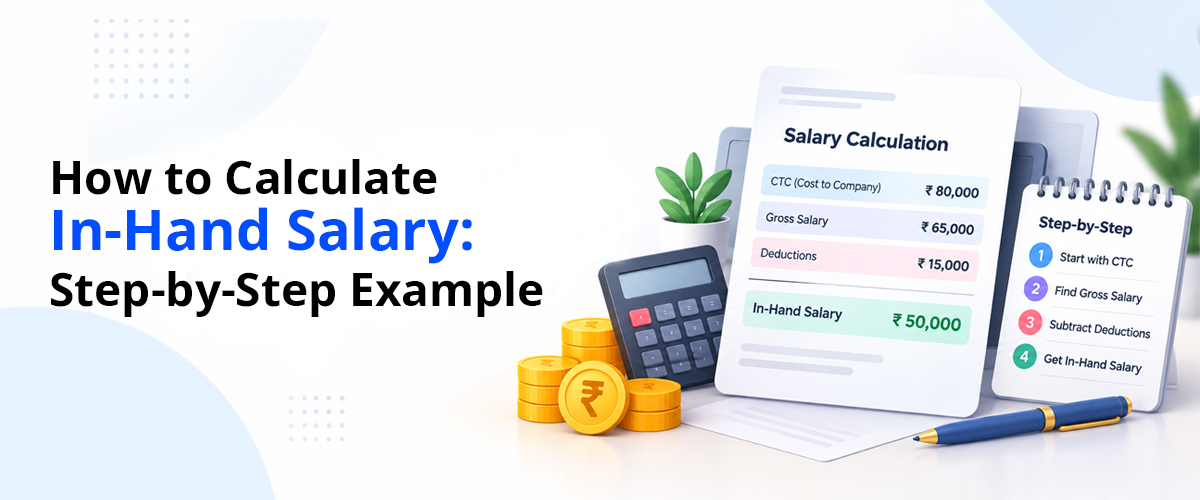
Follow these five steps to calculate in-hand salary from any CTC:
Salary components (what you earn)
-
- Find monthly CTC: divide annual CTC by 12.
- Remove employer contributions: subtract employer PF (and gratuity, if included) to get gross salary.
- Subtract employee PF and ESI: 12% of PF wages; ESI only if gross is ₹21,000 or less.
- Subtract professional tax: as per your state
- Subtract monthly TDS: calculate annual tax, add 4% cess, divide by 12.
Worked example: ₹12 LPA vs ₹18 LPA (new tax regime)
| Step | ₹12 LPA | ₹18 LPA |
|---|---|---|
| Monthly CTC | ₹1,00,000 | ₹1,50,000 |
| Less: Employer PF (12% of ₹25,000) | ₹3,000 | ₹3,000 |
| Gross salary | ₹97,000 | ₹1,47,000 |
| Less: Employee PF | ₹3,000 | ₹3,000 |
| Step | ₹12 LPA | ₹18 LPA |
|---|---|---|
| Less: Employee ESI | Nil (gross above ₹21,000) | Nil |
| Less: Professional tax (assumed) | ₹200 | ₹200 |
| Less: Monthly TDS | Nil | ₹11,943 |
| In-hand salary | ₹93,800 | ₹1,31,857 |
How the TDS was worked out:
-
-
- ₹12 LPA: annual gross ₹11,64,000 minus ₹75,000 standard deduction = ₹10,89,000 taxable. This is below ₹12 lakh, so the Section 87A rebate makes the tax nil.
- ₹18 LPA: annual gross ₹17,64,000 minus ₹75,000 = ₹16,89,000 taxable. Tax by slabs = ₹1,37,800. Add 4% cess = ₹1,43,312 a year, or about ₹11,943 a month.
-
Assumptions: employer PF is restricted to the ₹25,000 ceiling, gratuity is outside CTC, and professional tax is ₹200 a month. Your actual figures depend on your salary structure, state and tax regime.
How to Read Your Payslip: A Payslip Calculator Breakdown
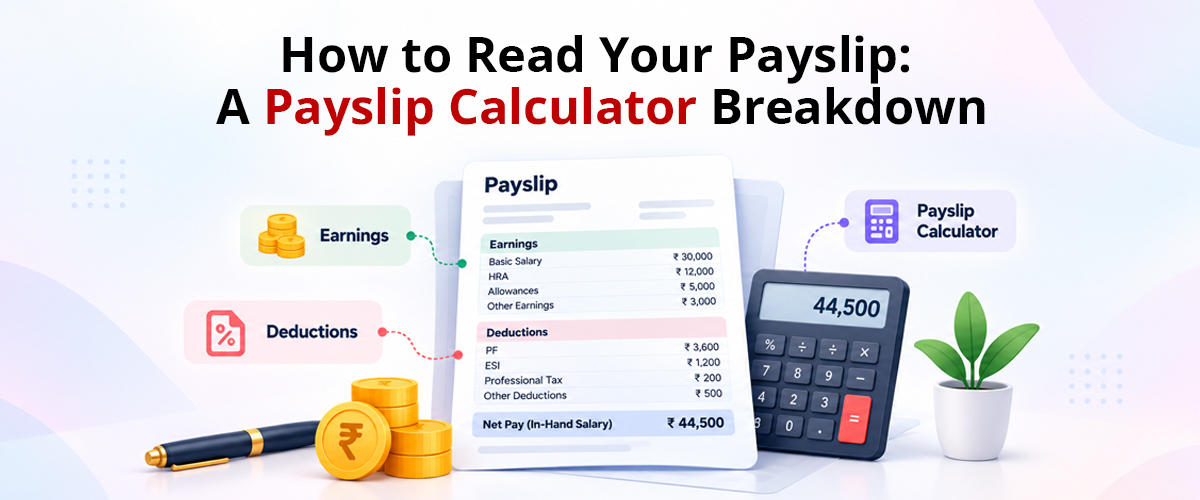
A payslip is the monthly proof of your salary calculation. A payslip calculator simply checks that every line adds up. Each payslip has three parts:
-
-
- Earnings: basic, HRA, special allowance, bonus and overtime.
- Deductions: employee PF, ESI, professional tax, TDS and loss of pay (LOP).
- Net pay: earnings minus deductions. This is your take-home salary.
-
If your in-hand amount changes from one month to the next, check the payslip for unpaid leave (LOP), a bonus, arrears or a change in TDS.
Payroll Calculator vs Payroll Software: What Businesses Need
A payroll calculator works well for one employee and one month. For a business, payroll is a recurring process with many moving parts.
| Task | Manual payroll | HRMS4U payroll software |
|---|---|---|
| Salary for one employee | Works | Works |
| Salary for the whole team | Repeated manually, one by one | Processed together automatically |
| Attendance and leave | Entered by hand | Pulled from Timesheet automatically |
| PF, ESI, PT and TDS | Recalculated each time rules change | Applied consistently from the salary structure |
| Payslips | Created separately in Word or Excel | Generated in one click for every employee |
| Reports | Built manually | Ready in the Reports module |
When rules change, such as the PF wage ceiling moving to ₹25,000 in September 2026, spreadsheet payroll is where errors begin.
Automate Payslip Generation and Payroll with HRMS4U
Calculating one in-hand salary is easy. Getting it right for 50 or 500 employees every month is not. HRMS4U Payroll turns the salary calculation formula into an automatic monthly process.

-
-
- Automated payroll processing: net pay is calculated from each employee’s salary structure, with no manual math.
- Accurate deductions: PF, ESI, professional tax and TDS are applied consistently, reducing salary errors.
- Attendance-linked pay: Timesheet and leave data feed directly into payroll, so LOP (Loss of Pay) and overtime are always correct.
- One-click payslip generation: clear payslips showing earnings, deductions and net pay for every employee.
- Employee self-service: staff view their own payslips, so HR gets fewer “why is my salary lower?” questions.
- Payroll reports: owners and finance teams see total salary cost and deductions at a glance.
- One connected platform: Payroll works with Core HR, Timesheet, Finance and Reports among 20+ HRMS4U modules.
- Cloud and mobile access: run payroll securely from anywhere.
-
In simple terms, HRMS4U is the in-hand salary calculator for your entire company, running every month without errors.
Frequently Asked Questions:
Whatis an in-hand salary calculator ?
An in-hand salary calculator is a tool that converts your CTC into the monthly amount you actually receive. It subtracts employer contributions, PF, ESI, professional tax and income tax.
Whatis the formula to calculate in-hand salary?
In-hand salary = Gross salary − (Employee PF + Employee ESI + Professional tax + TDS). Gross salary = CTC − employer contributions such as employer PF and gratuity.
How is take-home salary calculated from CTC?
Divide CTC by 12, remove employer PF and other employer-side costs to get gross salary, then subtract employee deductions and monthly TDS. What remains is your take-home salary.
Whatis the in-hand salary for 12 LPA?
Under the new tax regime in FY 2026-27, a ₹12 LPA CTC gives roughly ₹93,800 a month, assuming PF on a ₹25,000 ceiling, ₹200 professional tax and nil TDS. Your exact figure depends on your salary structure.
Is salary up to ₹12.75 lakh tax-free in FY 2026-27?
Yes, for salaried individuals under the new tax regime. The ₹75,000 standard deduction brings taxable income to ₹12 lakh, and the Section 87A rebate makes the tax nil.
How does a payslip calculator help?
A payslip calculator checks that the earnings, deductions and net pay on your payslip are correct, so you can spot errors such as wrong LOP or TDS.
How can companies automate payslip generation?
Companies can use payroll software like HRMS4U, which calculates salaries from attendance and salary structures, applies statutory deductions and generates payslips for all employees in one click.
Conclusion
An in-hand salary calculator helps employees understand their real take-home salary. For businesses, the same calculation must be repeated accurately for every employee, every month, as rules change. HRMS4U Payroll automates the salary calculation formula, statutory deductions and payslip generation in one cloud platform.
Stop calculating salaries by hand. Book a free HRMS4U demo and start your 14-day free trial today.